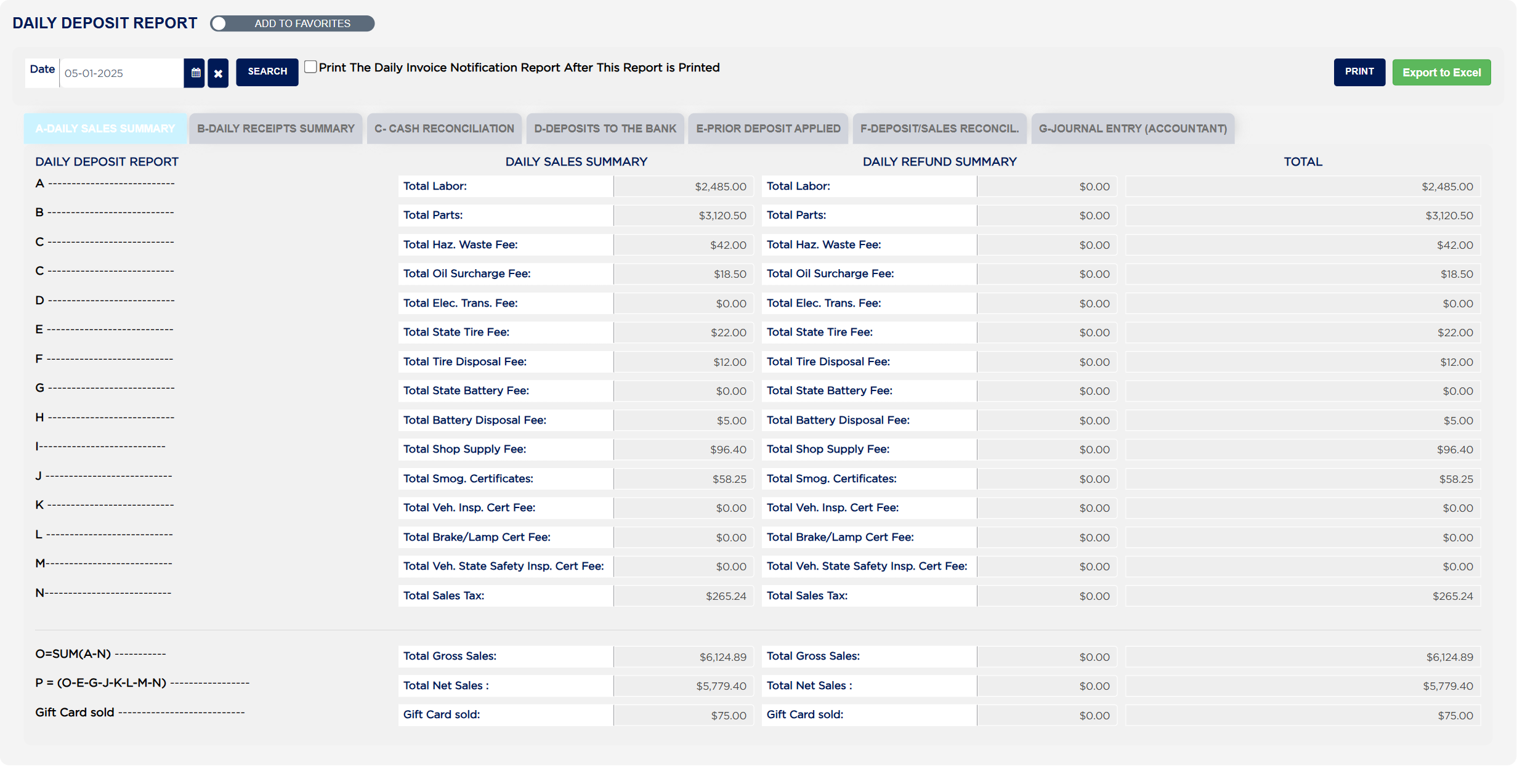
A-DAILY SALES SUMMARY has three columns, DAILY SALES SUMMARY for the invoices finalized on the day, DAILY REFUND SUMMARY for the invoices refunded on the day, and TOTAL, which is the sales figure less the refund figure. The lettered list on the left names the lines: Total Labor (A) and Total Parts (B) after discounts, then the fees and certificates Total Haz. Waste Fee and Total Oil Surcharge Fee (both C), Total Elec. Trans. Fee (D), Total State Tire Fee (E), Total Tire Disposal Fee (F), Total State Battery Fee (G), Total Battery Disposal Fee (H), Total Shop Supply Fee (I), Total Smog. Certificates (J), Total Veh. Insp. Cert Fee (K), Total Brake/Lamp Cert Fee (L), Total Veh. State Safety Insp. Cert Fee (M) and Total Sales Tax (N). Total Gross Sales is marked O=SUM(A-N) and Total Net Sales is marked P = (O-E-G-J-K-L-M-N), gross sales less the state fees, certificates and sales tax that the shop only collects; both are the figures stored on the invoices. Gift Card sold is the value of gift cards sold that day, listed separately because a gift card is not a sale until it is used.
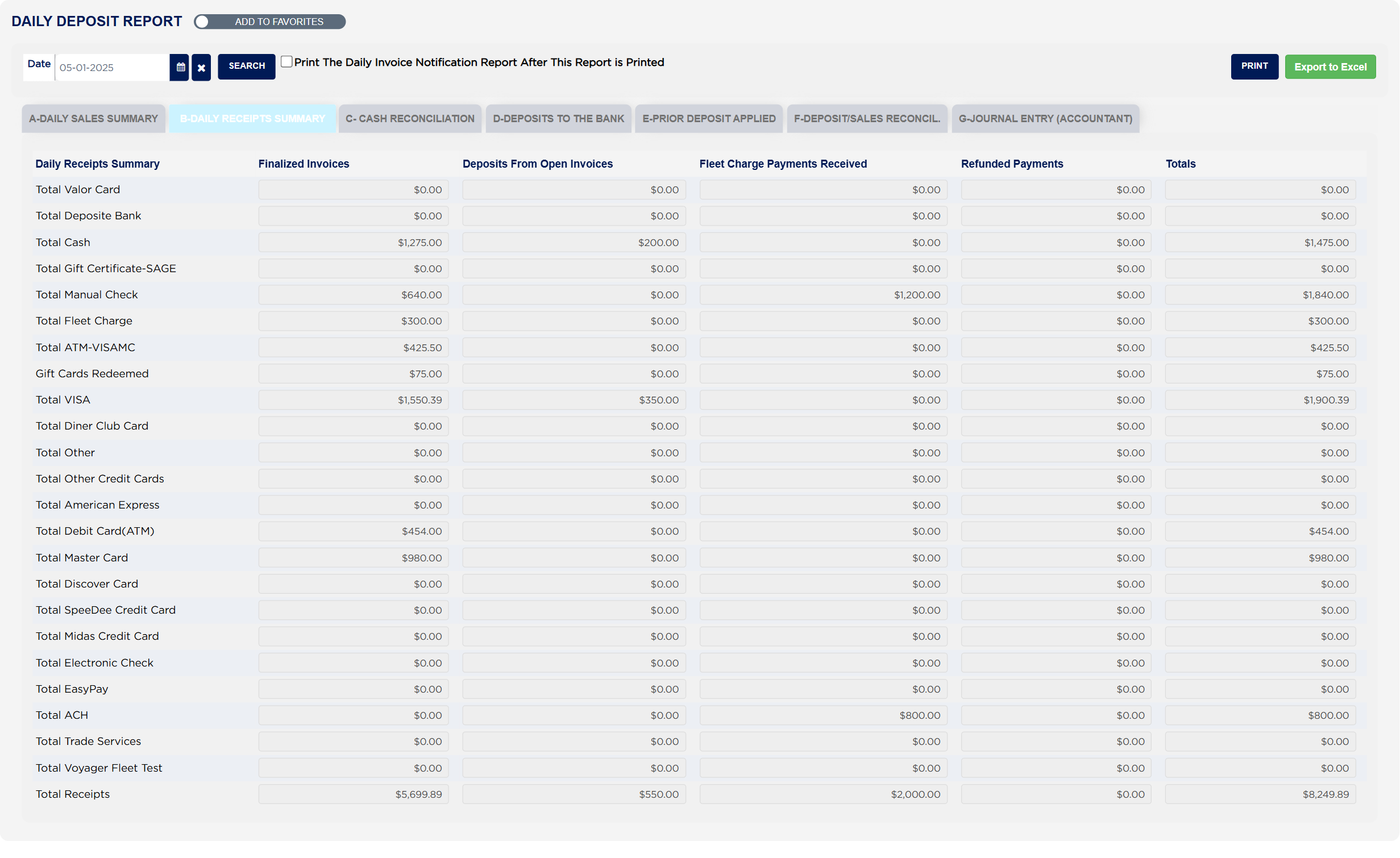
B-DAILY RECEIPTS SUMMARY lists every payment method the store has, one Total … line each, such as Total Cash and Total VISA, with Gift Cards Redeemed for payments made with a gift card. Finalized Invoices is the money taken that day on invoices finalized that day, including gift cards sold that day; Deposits From Open Invoices is money taken that day on invoices not finalized that day, such as a deposit on an estimate; Fleet Charge Payments Received is money received on fleet accounts rather than on an invoice; Refunded Payments is what was given back that day; and Totals is the first three less the refunds. Total Receipts at the foot adds each column.
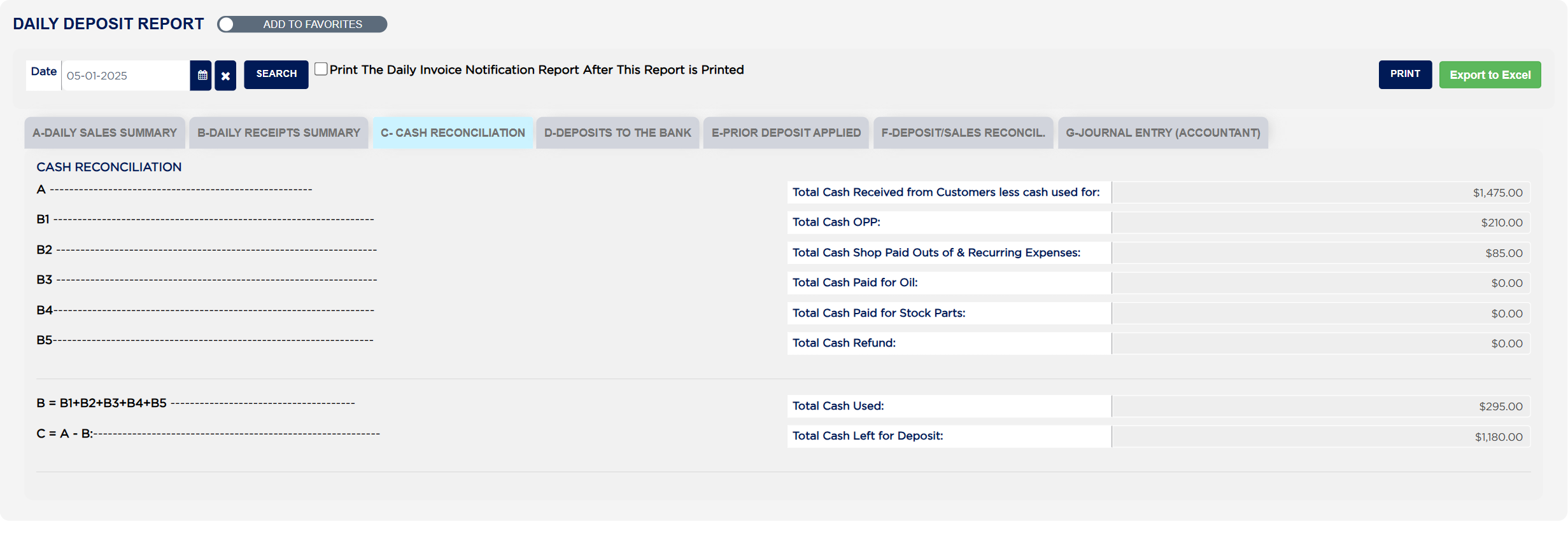
C- CASH RECONCILIATION works out the cash that should be in hand. Total Cash Received from Customers less cash used for (A) is the cash taken that day before any refund. The cash spent from the drawer follows: Total Cash OPP (B1) for outside part purchases, Total Cash Shop Paid Outs of & Recurring Expenses (B2), Total Cash Paid for Oil (B3), Total Cash Paid for Stock Parts (B4), all from the expenses paid in cash that day, and Total Cash Refund (B5). Total Cash Used is B = B1+B2+B3+B4+B5 and Total Cash Left for Deposit is C = A - B.
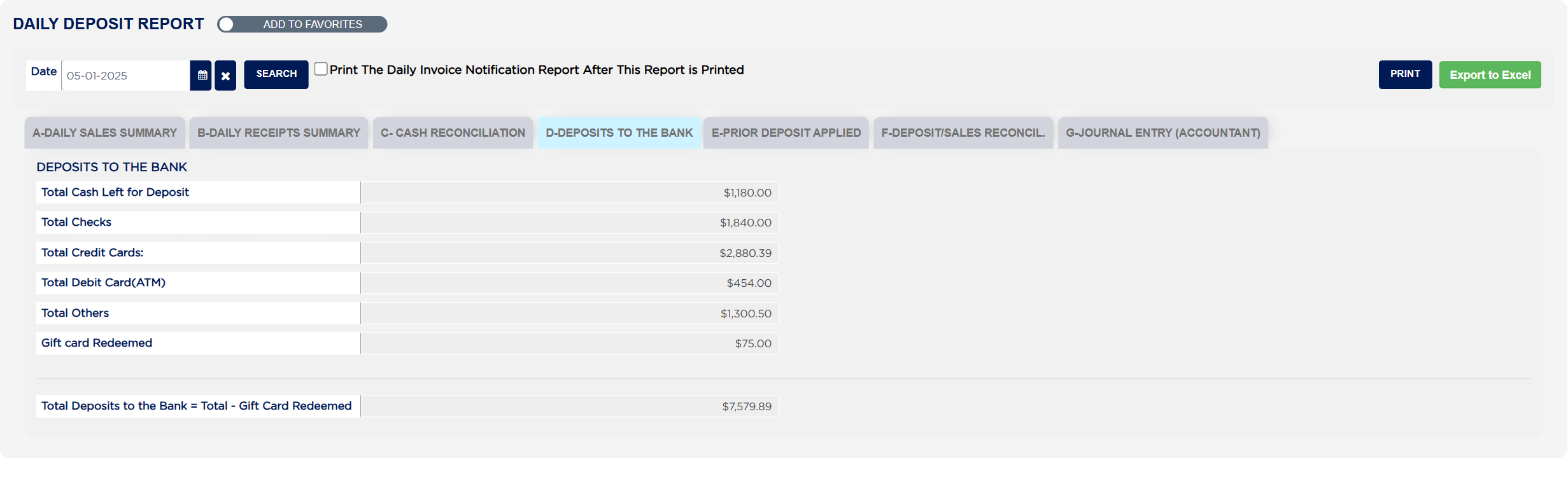
D-DEPOSITS TO THE BANK groups the day's receipts by how they reach the bank: Total Cash Left for Deposit from tab C (shown as zero if the cash used was more than the cash taken), Total Checks, Total Credit Cards, Total Debit Card(ATM) and Total Others, which holds every payment method not in the first groups, including store-added methods and gift cards. Gift card Redeemed is shown again and taken off, because a redeemed gift card brings no new money, so Total Deposits to the Bank = Total - Gift Card Redeemed.
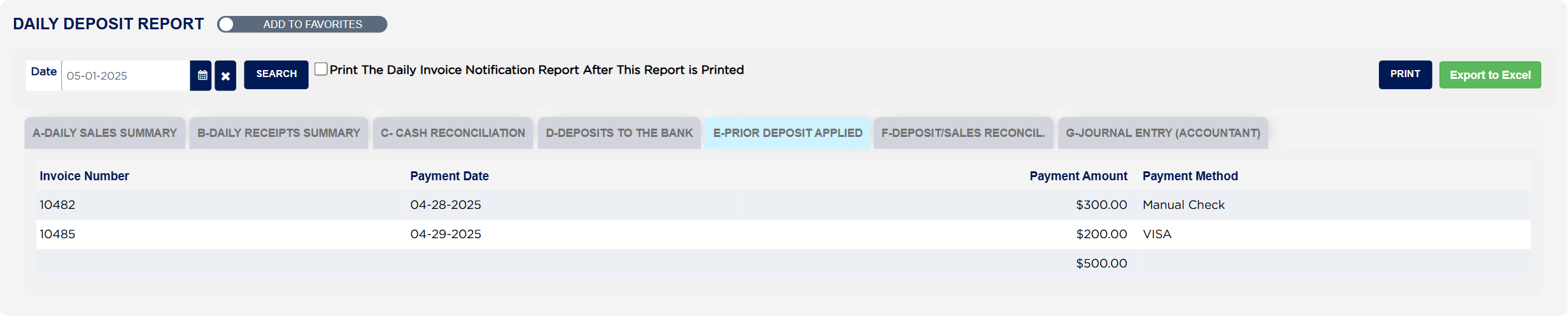
E-PRIOR DEPOSIT APPLIED lists the payments taken on earlier days on the invoices finalized today, one line per payment with the Invoice Number, Payment Date, Payment Amount and Payment Method, and their sum at the foot. This money was banked when it was taken, so it has to be added back when today's deposits are compared with today's sales.
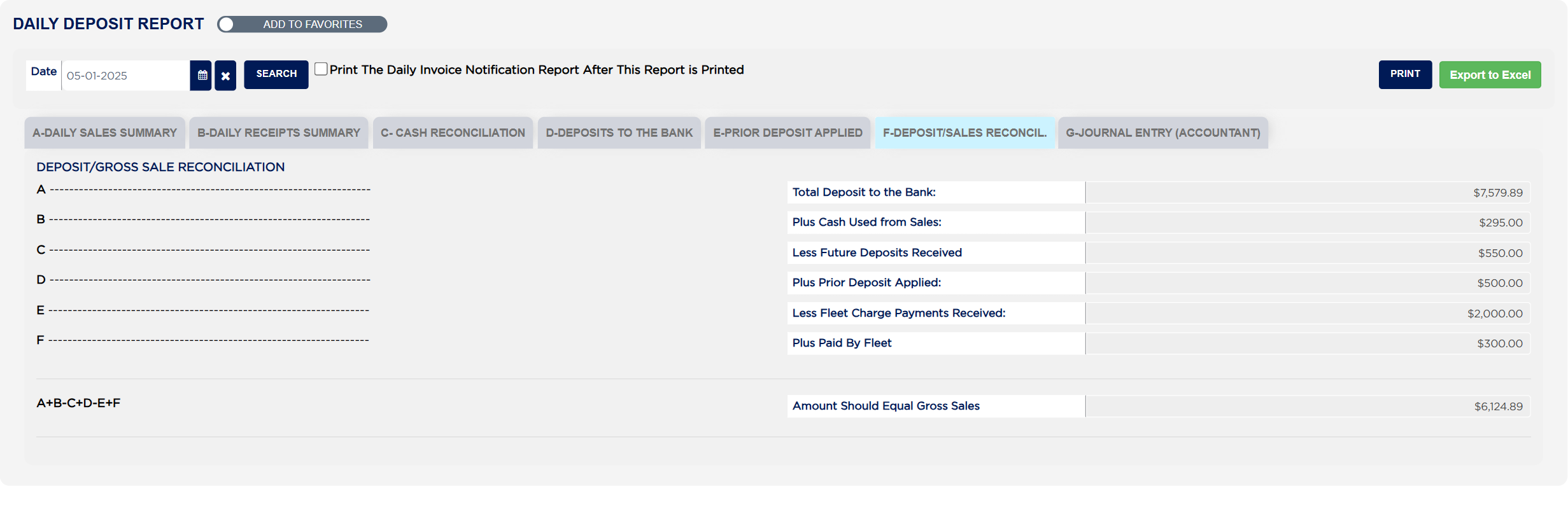
F-DEPOSIT/SALES RECONCIL. is the proof. Total Deposit to the Bank (A) from tab D, Plus Cash Used from Sales (B) from tab C, Less Future Deposits Received (C) from tab B, Plus Prior Deposit Applied (D) from tab E, Less Fleet Charge Payments Received (E) from tab B and Plus Paid By Fleet (F), the invoices charged to fleet accounts, combine as A+B-C+D-E+F into Amount Should Equal Gross Sales. When that figure matches Total Gross Sales on tab A, every dollar of the day is accounted for.
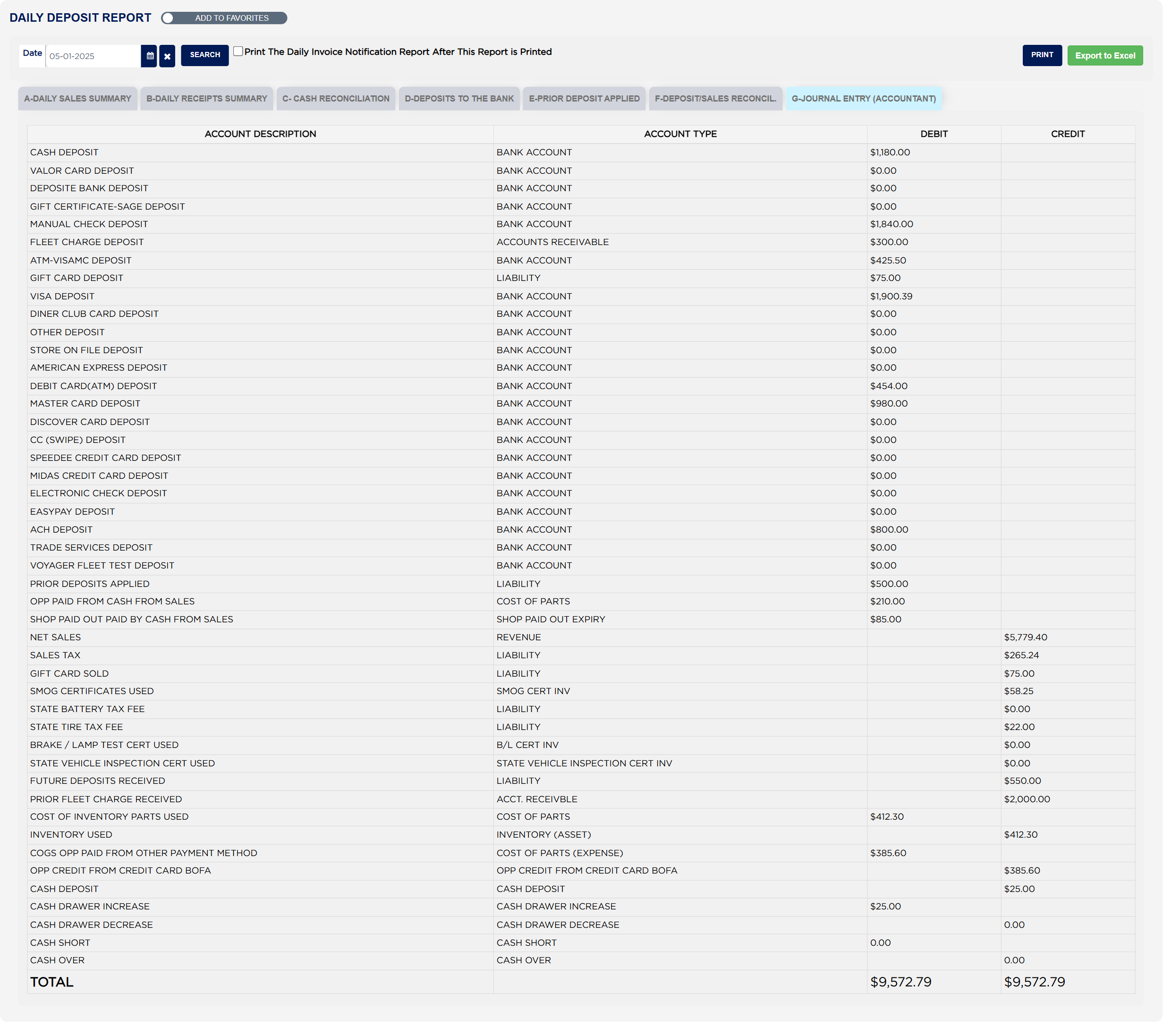
G-JOURNAL ENTRY (ACCOUNTANT) turns the day into debits and credits with an ACCOUNT DESCRIPTION, ACCOUNT TYPE, DEBIT and CREDIT for each line. The debits are the deposits by payment method, CASH DEPOSIT (the cash left for deposit from tab C) and one … DEPOSIT line per other method, then PRIOR DEPOSITS APPLIED, OPP PAID FROM CASH FROM SALES and SHOP PAID OUT PAID BY CASH FROM SALES. The credits are NET SALES, SALES TAX, GIFT CARD SOLD, SMOG CERTIFICATES USED, STATE BATTERY TAX FEE, STATE TIRE TAX FEE, BRAKE / LAMP TEST CERT USED, STATE VEHICLE INSPECTION CERT USED, FUTURE DEPOSITS RECEIVED and PRIOR FLEET CHARGE RECEIVED. COST OF INVENTORY PARTS USED (debit) and INVENTORY USED (credit) carry the stock cost of the parts used on the day's invoices, and COGS OPP PAID FROM OTHER PAYMENT METHOD (debit) with an OPP CREDIT FROM … line per purchase method (credit) record the outside parts bought for those invoices with a card or account. When the day's cash count has been saved from the End of Day form on the Home Screen, the lines CASH DEPOSIT (the difference between the counted bank deposit and the cash ARM expected), CASH DRAWER INCREASE or CASH DRAWER DECREASE, and CASH SHORT or CASH OVER follow. A negative amount is shown on the opposite side. The TOTAL row adds each column; the two totals agree when tab F balances.
The Add To Favorites switch beside the heading saves the report under Favorites on the Reports page. The report also opens as DAILY DEPOSIT REPORT from the End of Day Report. Which reports you see depends on your admin group permissions.