ARM Help

Shop Paid Outs Expense Report

Shop Paid Outs Expense Report lists the shop's own running expenses for a period, one line per payment: the shop paid outs taken from the drawer and every other shop expense account such as cleaning, insurance or equipment rental. Outside part purchases, oil purchases and part purchases are not included. Use it to see what went out of the drawer and to whom, to check the spend on one expense account, and to give your bookkeeper the shop's overheads for the month.

2 how-to answers 5 screenshots Open in ARM Markdown

How do I run the Shop Paid Outs Expense Report? #

  1. From the Home Screen, click Reports → Shop Expenses & Vendor Reports → Shop Paid Outs Expense Report. The page is headed DAILY SHOP PAID OUTS EXPENSE REPORT.
  2. Set the date range in the From / To selector. It opens on today only, so choose a wider range for a week or a month.
  3. To see one supplier or payee, type in Supplier Name, or leave it empty for all.
  4. To see one expense account, choose it in Select Account, for example Shop Paid Outs, or leave it on Select Account for every shop expense account. An account marked (R) in the list is a recurring expense.
  5. Click SEARCH to load the report. SHOW ALL clears the supplier and account and reloads.
  6. Click PRINT for a PDF copy or DOWNLOAD to export to a spreadsheet.
Shop Paid Outs Expense Report filters
Shop Paid Outs Expense Report list
Shop Paid Outs Expense Report table footer
Shop Paid Outs Expense Report filtered by account
Shop Paid Outs Expense Report printout

How do I total one expense account for a period? #

  1. From the Home Screen, click Reports → Shop Expenses & Vendor Reports → Shop Paid Outs Expense Report.
  2. Set From / To to the period. Example: 11-01-2025 to 12-31-2025.
  3. Choose the account in Select Account. Example: Shop Paid Outs.
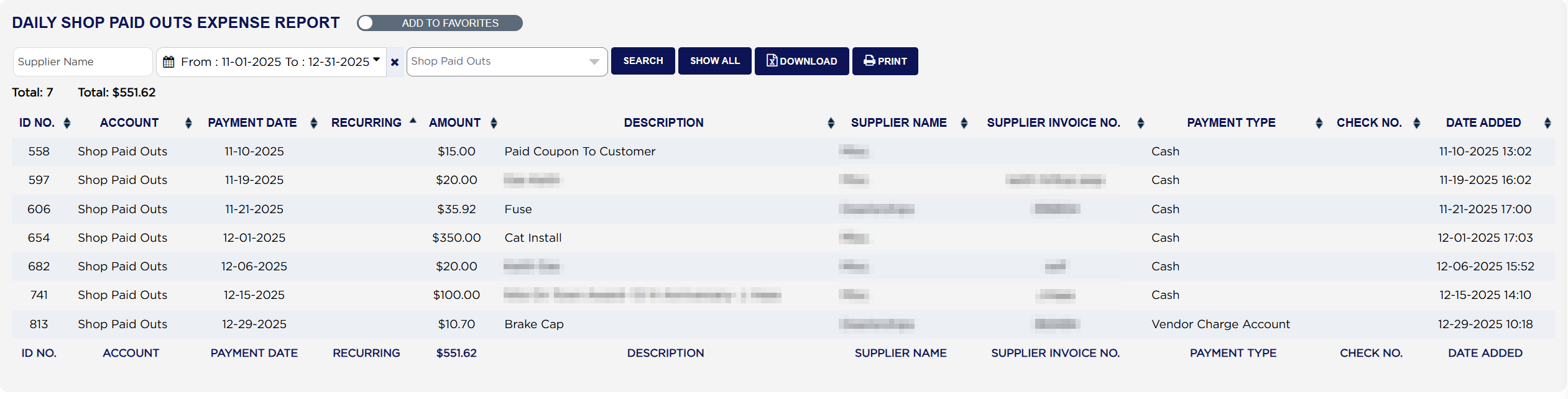
  4. Click SEARCH. The first Total: is the number of payments and the second Total: is the amount for the account. Example: Total: 7 Total: $551.62.
  5. To check it, add the AMOUNT column: $15.00 + $20.00 + $35.92 + $350.00 + $20.00 + $100.00 + $10.70 = $551.62. Here all seven lines fit on one page, so the foot row shows $551.62 too.
About this screen

Above the table, the first Total: counts the payments found and the second Total: is their amount for the whole report. Each line shows the ID NO. of the expense, the ACCOUNT it was posted to, the PAYMENT DATE, RECURRING, the AMOUNT, a DESCRIPTION of what the money was for, the SUPPLIER NAME or payee, the SUPPLIER INVOICE NO. where one was given, the PAYMENT TYPE such as Cash or Vendor Charge Account, the CHECK NO. for a cheque, and DATE ADDED, the date and time the expense was entered in ARM. Click any heading with arrows to sort by it.

RECURRING and CHECK NO. are often empty. Recurring expenses are easier to spot by the (R) after the account name. DESCRIPTION and SUPPLIER INVOICE NO. are free text typed by whoever entered the expense, so they carry whatever the shop wrote there.

The row at the foot of the table repeats the column names and shows one figure under AMOUNT: the total of the lines on the page you are looking at. When the report runs to more than one page, it is smaller than the money Total: above the table. Use the figure above the table for the period.

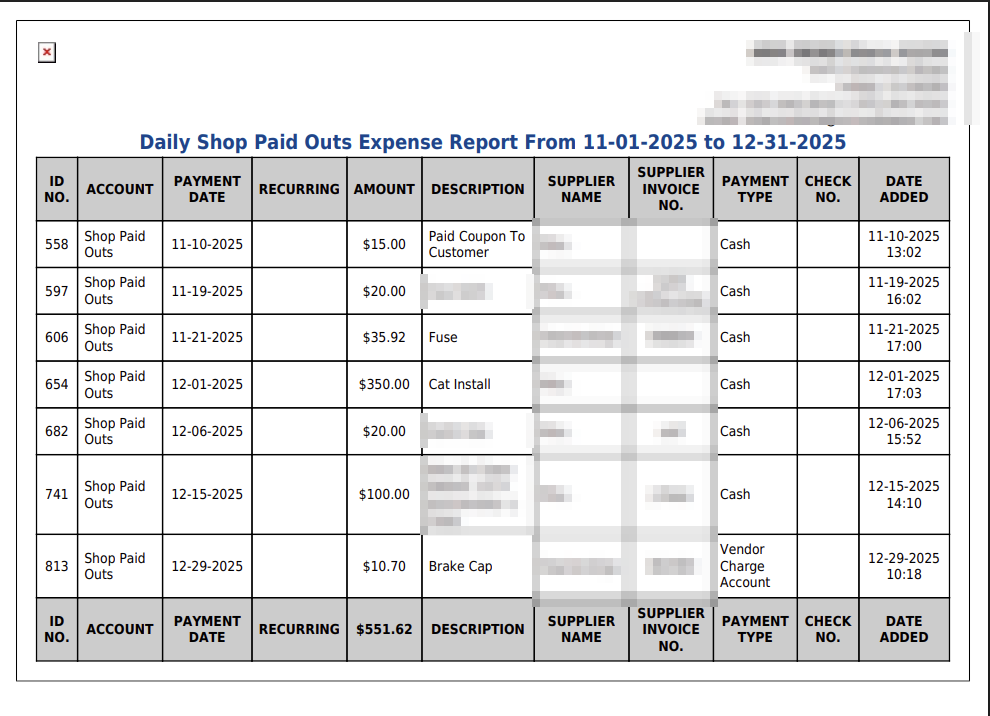
The printout is headed Daily Shop Paid Outs Expense Report From with your dates. It carries the same eleven columns and lists the same lines as the screen, with the total at the foot of the AMOUNT column.

For the same expenses added up account by account, run Shop Paid Outs By Account Category. To see every expense including part purchases, run All Expense Report.


Ask AI